Forms

An HTML form is used to collect user input. The user input is most often sent to a server for processing. like the search box in the middle of Google’s homepage,
-
The <form> element is a container for different types of input elements, such as: text fields, checkboxes, radio buttons, submit buttons, etc.
-
An HTML form is used to collect user input. The user input is most often sent to a server for processing.
-
The HTML <form> element is used to create an HTML form for user input.
-
The <form> element is a container for different types of input elements, such as: text fields, checkboxes, radio buttons, submit buttons, etc.
-
The HTML <input> element is the most used form element.
-
An <input> element can be displayed in many ways, depending on the type attribute.
-
The <input type=”text”> defines a single-line - input field for text input.
-
The <label> tag defines a label for many form elements.
-
The <label> element is useful for screen-reader users, because the screen-reader will read out loud the label when the user focus on the input element.
-
The <input type=”radio”> defines a radio button. Radio buttons let a user select ONE of a limited number of choices.
-
The <input type=”checkbox”> defines a checkbox. Checkboxes let a user select ZERO or MORE options of a limited number of choices.
-
The <input type=”submit”> defines a button for submitting the form data to a form-handler. The form-handler is typically a file on the server with a script for processing input data.
List types in HTML

HTML lists allow web developers to group a set of related items in lists.
There are three list types in HTML:
- unordered list — used to group a set of related items in no particular order.
- ordered list — used to group a set of related items in a specific order.
- description list — used to display name/value pairs such as terms and definitions.
Lists can be nested inside one another. Each list type has a specific purpose and meaning in a web page.
to know more about lists in html read this book Chapter 3: “Lists” (pp.62-73)
HTML TABLES
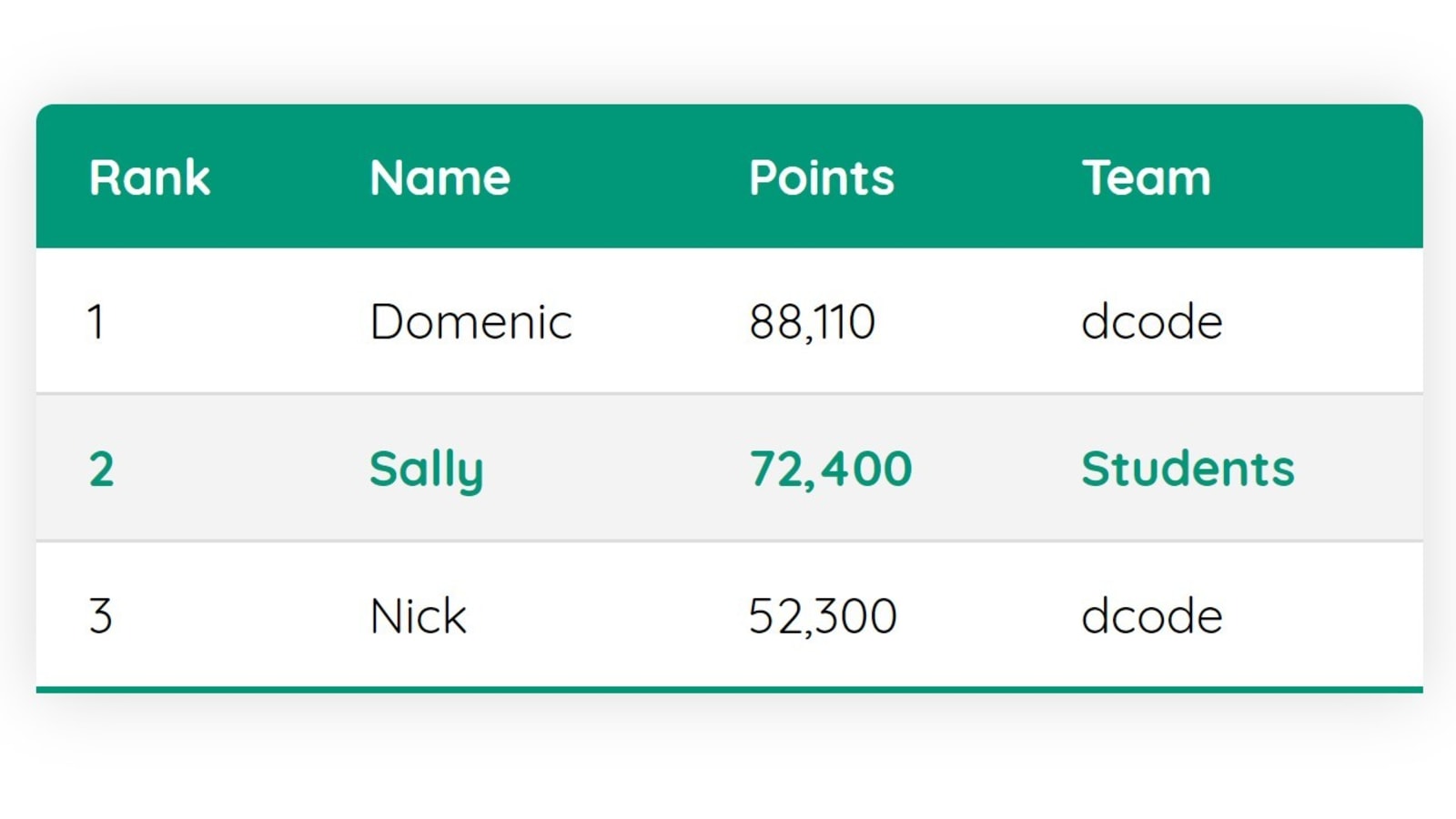
The HTML tables allow web authors to arrange data like text, images, links, other tables, etc. into rows and columns of cells.
The HTML tables are created using the <table> tag in which the <tr> tag is used to create table rows and <td> tag is used to create data cells. The elements under <td> are regular and left aligned by default
Table Heading
Table heading can be defined using <th> tag. This tag will be put to replace <td> tag, which is used to represent actual data cell. Normally you will put your top row as table heading as shown below, otherwise you can use <th> element in any row. Headings, which are defined in <th> tag are centered and bold by default.
Summary
- The <table> element is used to add tables to a web page.
- A table is drawn out row by row. Each row is created with the <tr> element.
- Inside each row there are a number of cells represented by the <td> element (or <th> if it is a header).
- You can make cells of a table span more than one row or column using the rowspan and colspan attributes.
- For long tables you can split the table into a <thead>, <tbody>, and <tfoot>. to read more about tables in html red this book
What are Events?

We can fill in the blanks in this statement in a bajillion different ways. The first blank calls out something that happens. The second blank describes the reaction to that. Here are some examples of this statement filled out:
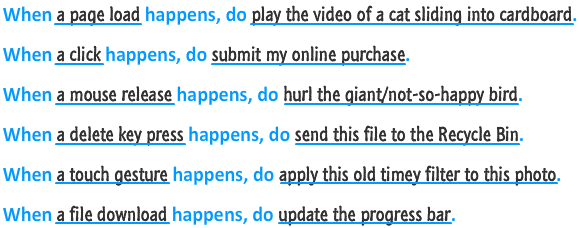 This generic model applies to all of the code we’ve written together. This model also applies to all of the code our favorite developer/designer friends wrote for their applications. There is no way of escaping this model, so…there is no point in resisting. Instead, we need to learn to embrace the star of this model, the very talented critter known as the event.
to know more about events visit this site or you can red this book Chapter 6: “Events” (pp.243-292)
This generic model applies to all of the code we’ve written together. This model also applies to all of the code our favorite developer/designer friends wrote for their applications. There is no way of escaping this model, so…there is no point in resisting. Instead, we need to learn to embrace the star of this model, the very talented critter known as the event.
to know more about events visit this site or you can red this book Chapter 6: “Events” (pp.243-292)